Principle species colonised
In the UK, it mostly occurs on beech trees, but it also sometimes occurs on other broadleaved trees and infrequently on conifers.
Area affected
The fungus mostly damages the underside of the tree’s primary root structure.
Type of decay
White rot is caused by Meripilus, however there is an initial “soft-rot” phase. It has a special capacity to break down pectin, a material that aids in cell adhesion. Wood that has decayed becomes brittle and prone to longitudinal and cross-grain fractures..
Fruit body / fungal structures
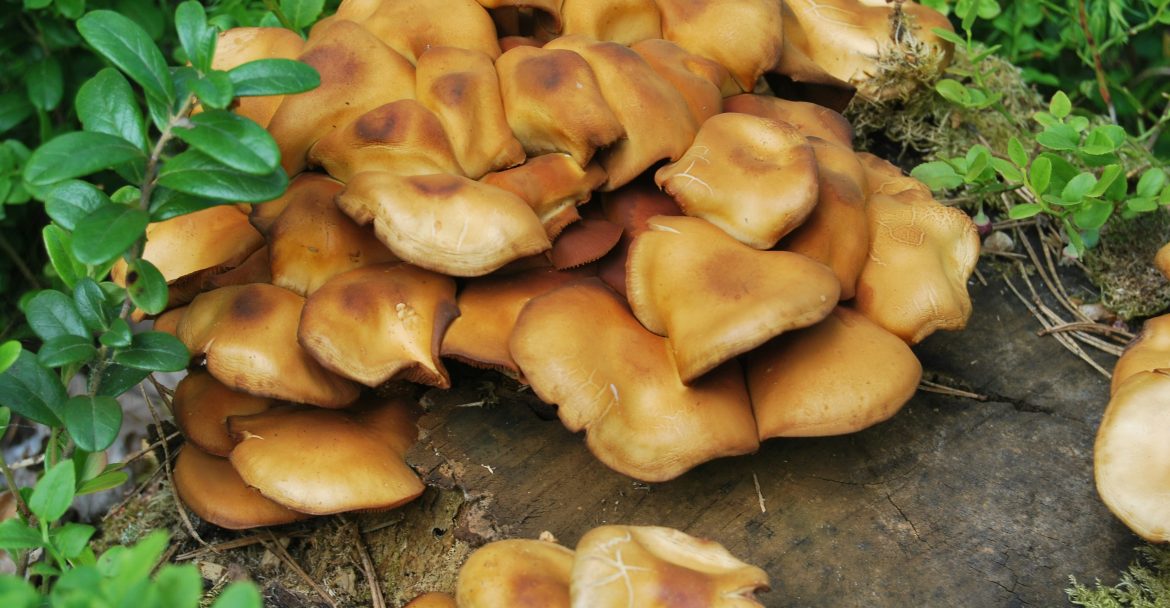
Usually found between buttresses, masses of overlapping fronds that originate from a tuber-like fungal mass can also occasionally be seen on the ground above decomposing roots, sometimes even a few meters from the tree’s base. The bulk can be up to one metre wide, yet individual fronds are only 100–200 mm across. The upper sides have a paler border and are either chestnut or yellowish-brown. When gently pushed, the undersides become white and bruise black, however this could take 15 to 20 minutes to show.
Season and persistents The fruit bodies are short-lived, annual, and can rapidly deteriorate into a slimy, black substance. They can last for several months in arid environments. Fruit from fresh crops doesn’t necessarily appear every year.
Significance / Effect / Impact
Trees with huge fruiting masses of M. giganteus have a rather high rate of uprooting, therefore careful and frequent investigation will be necessary if these trees are to be kept. Since some afflicted trees are uprooted while still displaying lush foliage, while others die standing, the state of the crown is not a good indicator of the degree of root system deterioration.
Additionally, as the fungus is sometimes limited to the deeper roots, the state of the roots close to the surface can be misleading. However, if the fungus is limited to the centre wood, trees can stay very stable.