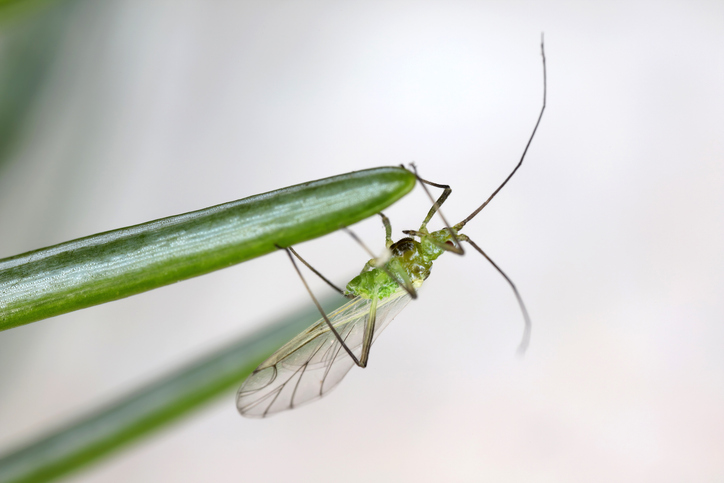
Green spruce aphid (Elatobium abietinum)
Principle species colonised. Green spruce aphids are mostly exclusively of spruce trees Identification. Adult green spruce aphids are small, pale to dark green, and range in length from 1 to 2 mm (see above and top picture). Because of this, it is unlikely that they will be visible unless the tree is examined closely at […]

Horse Chestnut leaf miner (Cameraria ohridella)
Principle species colonised. Typically Horse Chestnut. Identification. The larvae of the moth Cameraria ohridella are known as horse chestnut leaf miners. The adult moths are very little, measuring just 4 to 5 mm. They have a deep brown hue with black-edged chevrons of brilliant white. The mature female deposits up to 180 eggs on freshly […]

Eight- Toothed Spruce bark beetle.
Principle species colonised. Because it loves stressed and dying trees, the eight-toothed spruce bark beetle is most commonly found on fallen trees. The bug will migrate to living Spruce and Pine trees if the population grows. Identification. The eight-toothed spruce bark beetle is a cylindrical insect that is about 5 mm long, hairy, glossy, and […]

Large pine weevil (Hylobius abietis)
Principle species colonised. The Large pine weevil can attack a variety of young conifer and broadleaved tree species. Identification. Adult weevils are dark brown with patches of yellow or light brown hairs organised in random rows on the abdomen/wing cases. They are roughly 10 to 13 mm long (not including the extended “snout” or rostrum). The […]

Oak processionary moth (Thaumetopoea processionea)
Principle species colonised. The most critical clue is the host. OPM lives and feeds almost exclusively on oak trees. If you see caterpillars or nests on other tree species (like blackthorn, hawthorn, or fruit trees), they are likely a different, often harmless, species like the Lackey or Ermine moth. Identification. April through July is when […]
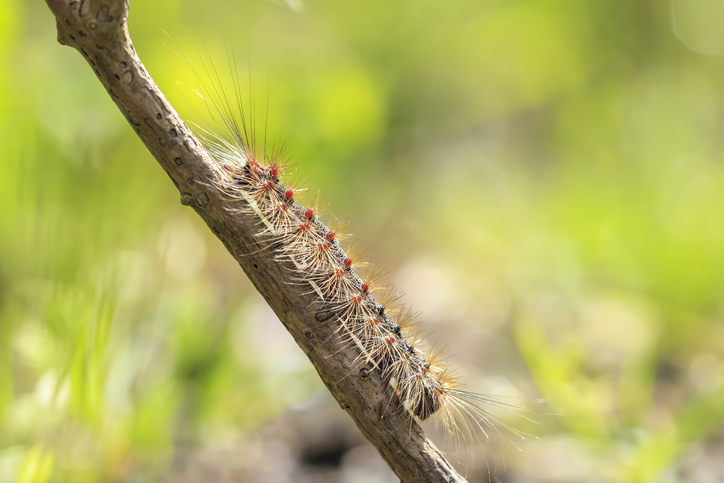
Gypsy moth (Lymantria dispar)
Principle species colonised. Gipsy moth caterpillars consume the leaves of a wide range of broadleaved tree and shrub species, with a predilection for poplars (Populus species) and oaks (trees of the Quercus genus) in forest settings. They will also consume a variety of small tree and shrub species found in gardens, such as attractive conifers, […]