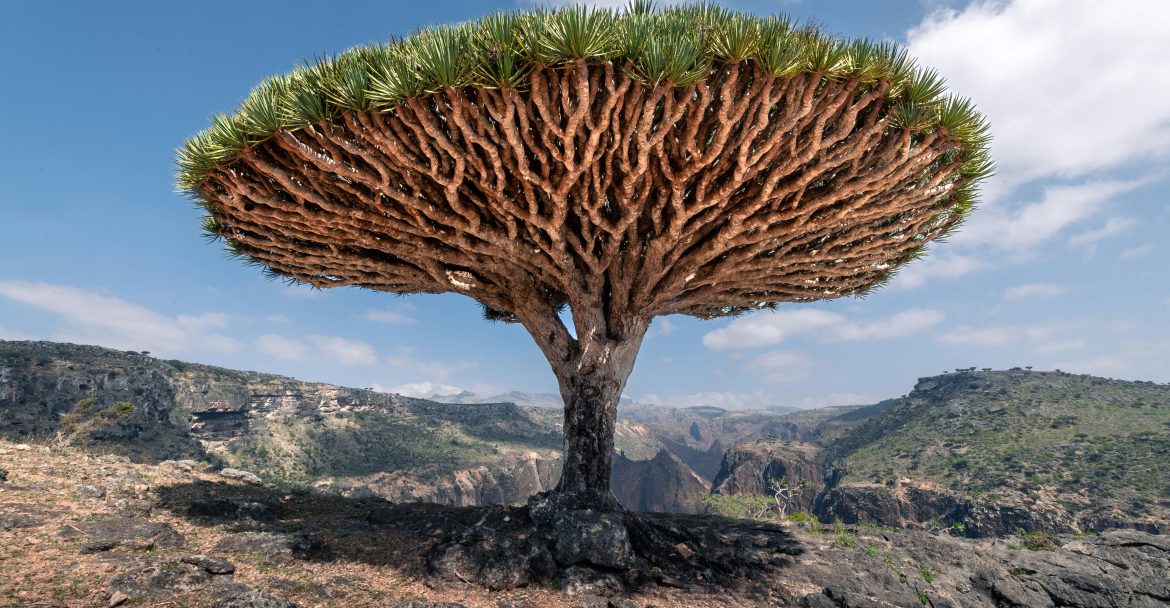
The Umbrella of Socotra
On a rugged plateau overlooking the Arabian Sea, a silhouette rises from the limestone that defies the laws of modern botany. It does not wave in the breeze like a willow, nor does it reach for the heavens like a redwood. Instead, the Dragon’s Blood Tree (Dracaena cinnabari) sits like a giant, inverted mushroom—or perhaps a green umbrella discarded by a passing titan.
Isolated for millions of years on the Socotra Archipelago of Yemen, this “Living Fossil” has evolved a geometry designed for one thing: the art of survival in a land where water is a ghost.
Nature’s Own Plumbing
The peculiar shape of the Dragon’s Blood Tree is not a stylistic choice; it is a masterpiece of hydraulic engineering. In an environment where rainfall is scarce, the tree relies on the heavy morning mists that roll in from the sea.
-
The Canopy: The densely packed branches form a tight, hexagonal pattern that acts as a catchment area.
-
The Descent: Moisture from the mist condenses on the waxy leaves and is channeled inward toward the central trunk.
- The Shade: Most importantly, the “umbrella” casts a deep shadow over the root system, preventing the precious water from evaporating before the soil can drink it.
The Crimson Heart
The tree earns its legendary name from the thick, garnet-colored resin that seeps from its bark when wounded. To the local Soqotri people, this “Dragon’s Blood” is a panacea. Since the time of the Roman Empire, this resin has been harvested and traded across the Silk Road.
“It is the blood of the earth,” says a local harvester. “It heals the skin, dyes the wool, and protects the wood.”
Chemically, the resin is rich in antioxidant phenols, which the tree uses to seal wounds and ward off pests. Historically, it was even rumored to be the secret ingredient in the varnish of Stradivarius violins, giving them their iconic, fiery hue.
A Fragile Kingdom
Despite its ancient pedigree, the Dragon’s Blood Tree is facing a modern crisis. The delicate balance of the Socotra ecosystem is shifting.
Conservationists are racing to protect the remaining groves. On Socotra, the trees are more than just a tourist attraction; they are the anchors of the island’s biodiversity. Under their shade, rare endemic plants and reptiles find a cool sanctuary that exists nowhere else on the planet.
As the sun sets over the Diksam Plateau, the trees look like sentinels from another world, standing guard over a landscape that is slowly disappearing. The question remains: can a tree that survived the era of the dinosaurs survive the era of man?