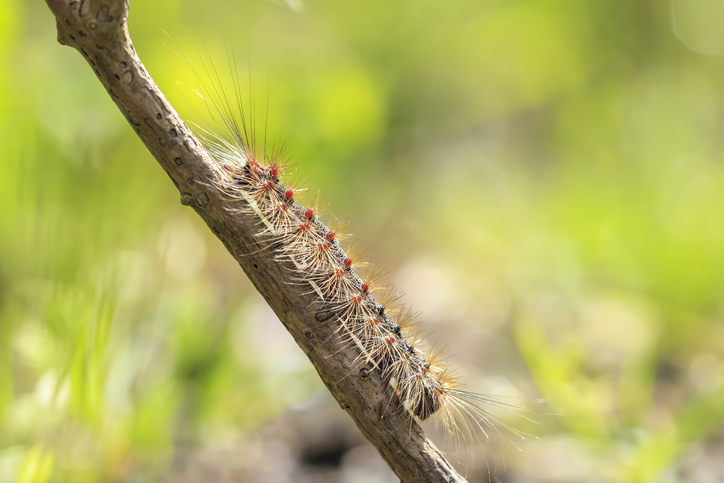
Principle species colonised.
Gipsy moth caterpillars consume the leaves of a wide range of broadleaved tree and shrub species, with a predilection for poplars (Populus species) and oaks (trees of the Quercus genus) in forest settings.
They will also consume a variety of small tree and shrub species found in gardens, such as attractive conifers, and particularly in hedges, where beech (Fagus spp.) hedges are a common target.
Identification.
The female gipsy moth deposits its eggs in enormous plaques that are 3–4 cm long and covered in brown or yellowish hairs. Over the winter, these hairs aid in protecting the eggs.
Type of symptoms.
The plaques are typically found on bark fissures, but they can also be found on walls, fences, or any other rough, protected surface in urban settings.
The threat to host.
When population densities are high, gipsy moth caterpillars can cause significant damage, especially to small trees. After an infestation, a host plant will typically recover without losing any of its vigour. Repeated infestations, however, can have a detrimental effect on the plant’s long-term health and ultimately result in tree death.
Impact / Effect / Significance
In contrast to oak processionary moth hairs, gipsy moth hairs do not have a significant negative impact on human health. Though symptoms differ based on a person’s susceptibility, the hairs are a possible allergy, much like all hairy caterpillars. It is normally preferable to avoid touching any caterpillar that has lengthy hair.