Principle species colonised.
The Red-necked Longhorn Beetle (RNLB) primarily targets trees within the Prunus genus.
Identification.
The adult beetle is most active during the summer (June to August).
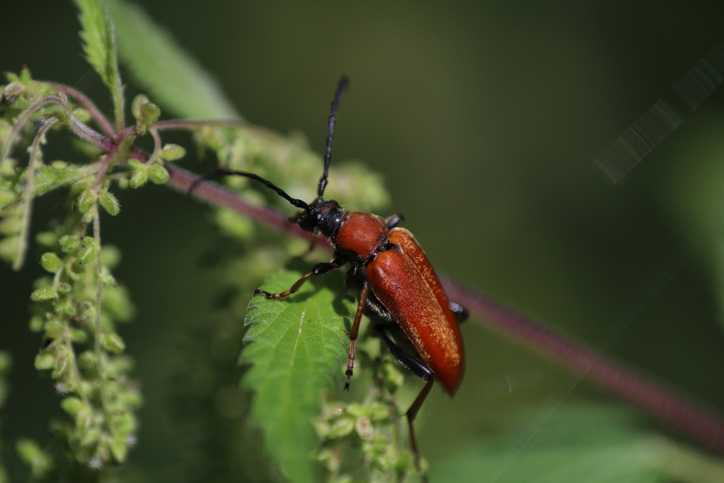
Its most famous feature is a bright red thorax (the section between the head and the wings). The rest of the body, including the wing cases (elytra), is a glossy, jet-black or deep blue-black.Its a large beetle, typically 20–40 mm long (roughly the size of a thumb) and has very long and black. In males, the antennae can be twice as long as the entire body.
Type of symptoms.
infestations are often “hidden” within the tree for several years before the full extent of the damage is visible.
Large amounts of coarse, reddish-brown sawdust-like waste (frass) expelled from the trunk.This often piles up at the base of the tree or in the forks of branches. Large, oval or circular holes (roughly 10–12 mm wide) on the trunk and main branches where adults have emerged.
Symptoms include wilting leaves, yellowing foliage, and “dieback” (death of branches starting from the tips) due to the larvae disrupting the tree’s internal plumbing. In severe cases, the bark may bulge or crack over areas where larvae have created extensive galleries (tunnels).
The threat to host.
The RNLB is a primary pest, meaning it can attack and kill perfectly healthy trees.
The larvae bore into the phloem (the inner bark) and then deep into the sapwood and heartwood. This severs the pathways for water and nutrients.Extensive tunneling compromises the physical strength of the tree, making branches or the entire trunk prone to snapping. Because larvae live deep inside the wood, standard chemical sprays are largely ineffective. Once a tree is heavily infested, it usually cannot be saved and must be felled and destroyed to prevent the beetle from spreading.
Impact / Effect / Significance
In regions like Italy and China, the beetle has devastated orchards. It can reduce fruit yields significantly before eventually killing the tree. The UK fruit industry and ornamental nursery trade face a massive economic threat. An established population could lead to the loss of thousands of productive trees and expensive quarantine measures.
Many Prunus species are staples of urban landscaping and traditional gardens. The beetle could permanently alter these landscapes by removing iconic species like flowering cherries. As a “Quarantine Pest,” it is under strict surveillance. If found in the UK, it triggers immediate government action (felling and burning) to prevent an outbreak from becoming permanent.