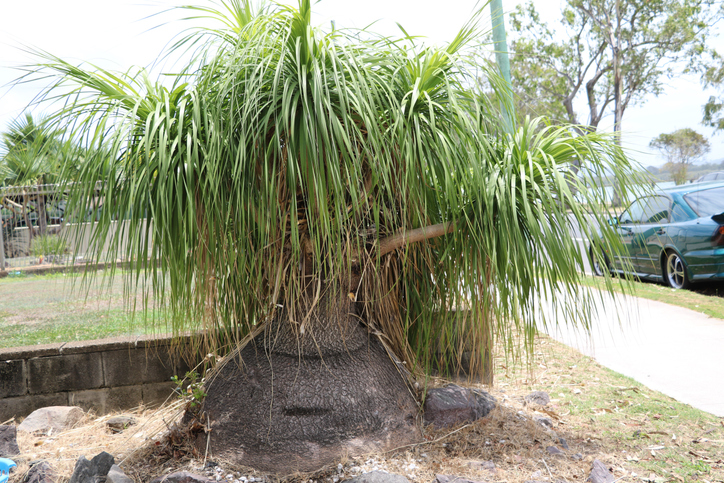
The Desert’s Living Reservoir: The Legend of the Elephant Foot
In the arid, rocky canyons of eastern Mexico, survival is carved from the ability to hold on. Here, amidst the heat-haze of Veracruz and San Luis Potosí, rises a botanical anomaly that has captured the imagination of gardeners and explorers alike: the Elephant Foot Tree (Beaucarnea recurvata).
While its common name suggests a creature of the savannah, this plant—more widely known as the Ponytail Palm—is neither a palm nor a pachyderm. It is a succulent member of the Asparagus family, a resilient survivor that has mastered the art of the long drought.
The Architecture of Endurance
The most striking feature of the Beaucarnea is its dramatic, bulbous base, known as a caudex. Grey, wrinkled, and immensely thick, it bears an uncanny resemblance to the foot of an elephant. This is not merely an aesthetic quirk; it is a vital survival organ.
-
Hydraulic Hoarding: The elephantine base serves as a massive internal reservoir, allowing the plant to store water for months, or even years, between infrequent desert rains.
-
The Crown: From the apex of this woody “foot” erupts a fountain of thin, leathery, strap-like leaves. These leaves curve gracefully downward—hence the name recurvata—to minimize water loss through evaporation while channeling every drop of morning dew toward the center of the plant.
A Case of Mistaken Identity
In the world of botany, the “elephant foot” moniker is a coveted title, shared by a small guild of unrelated plants that have arrived at the same architectural solution through convergent evolution:
-
The Spineless Yucca (Yucca elephantipes): A taller, more architectural relative whose base thickens significantly as it matures, though it lacks the true bulbous curves of the Beaucarnea.
-
The Tortoise Plant (Dioscorea elephantipes): A strange, slow-growing vine from South Africa. Its base is covered in thick, corky plates that resemble a tortoise’s shell, earning it a spot in the “elephant foot” family of nomenclature.
“It is a testament to nature’s efficiency; across different continents and families, the ‘foot’ remains the ultimate insurance policy against a thirsty world.”
From the Canyon to the Living Room
Despite its rugged origins, the Beaucarnea recurvata has become a global favorite in the world of interior design. Its “easy-care” reputation stems from its wild heritage—it is virtually indestructible, requiring little more than a sunny corner and the occasional drink. In its native habitat, these trees are slow-burning giants, capable of living for centuries and reaching heights of 30 feet. In the home, they remain miniature sentinels, silent reminders of the Mexican wilderness that can thrive on neglect.
As of 2026, habitat loss in its native range has made wild specimens increasingly rare, turning the ponytail palms in our homes into important ambassadors for one of the world’s most unique desert ecosystems.