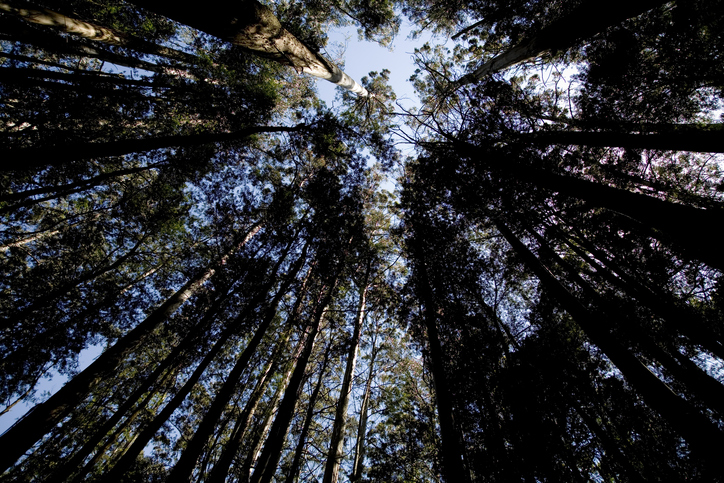
The Vertical Frontier: Tasmania’s Defiant King
In the misty, primordial depths of southern Tasmania’s Arve Valley, the earth reaches for the heavens with an intensity found nowhere else in the Southern Hemisphere. Here, amidst the damp ferns and towering timber, stands Centurion—a Mountain Ash (Eucalyptus regnans) that serves as the world’s reigning champion of flowering life.
The Tallest Blossom on Earth
Centurion is not just a tree; it is the tallest known angiosperm—or flowering plant—on the planet. While the Redwoods of California may claim the title of world’s tallest overall, Centurion holds the crown for the vast kingdom of plants that produce flowers and seeds.
The biography of this giant is written in staggering numbers and narrow escapes:
-
The Stature: In 2018, Centurion was measured at a monumental 100.5 meters (330 feet). However, as of 2026, recent aerial and ground surveys show the tree currently stands at approximately 96 meters. This slight reduction is a scar of time—the result of the long-term stress and crown dieback following the brutal fire seasons of the last decade.
-
The Mass: With a girth of over 4 meters and a trunk volume estimated at 268 cubic meters, Centurion possesses a physical gravity that commands the surrounding forest.
-
The Age: Estimated to be between 300 and 500 years old, it was already a soaring spire when the first European sails appeared on the Tasmanian horizon.
A Discovery of Light and Legend
Centurion remained hidden from the modern world until August 2008, when it was “plucked” from the canopy by the digital eyes of LiDAR technology. Its name was a stroke of serendipity; Forestry Tasmania had reserved the title “Centurion” for the 100th “noble tree” found during their mapping—only to discover that this 100th find also happened to be roughly 100 meters tall.
In a nod to Australian sporting heritage, the tree earned the nickname “The Bradman.” In 2014, its height was recorded at 99.82 meters, a near-perfect mirror of the legendary cricket batting average (99.94) of Sir Donald Bradman—a figure that represents the pinnacle of Australian achievement.
The Scars of Survival
To visit Centurion is to witness the resilience of the Australian bush. In 2019, catastrophic bushfires roared through the Huon Valley, licking at the very base of the giant. Centurion survived, but it was a close-run thing.
-
The Damage: Today, the base of the trunk bears a deep, charred hollow—a fresh “cave” carved by the flames.
-
The Recovery: Despite the blackened bark at its feet, Centurion’s crown remains a defiant green, pulsing with the hydraulic pressure required to pump water nearly 100 meters into the sky.
“Centurion is a living bridge between the earth and the atmosphere, a sentinel that has survived fire and storm to remain the high-water mark of botanical evolution.”
Into the Arve Valley
For the intrepid traveler, Centurion offers no easy audience. Located nearly two hours south of Hobart near the Tahune Airwalk, the “trail” to the giant is a rugged, untracked scramble through dense scrub and deep mud, marked only by occasional ribbons of tape.
As of 2026, Centurion remains protected as a designated “giant tree,” yet it stands in a precarious position—a biological island surrounded by active timber production zones. Its continued existence is a testament to the complex balance between Tasmania’s industrial heritage and its status as a sanctuary for the world’s most extraordinary living monuments.