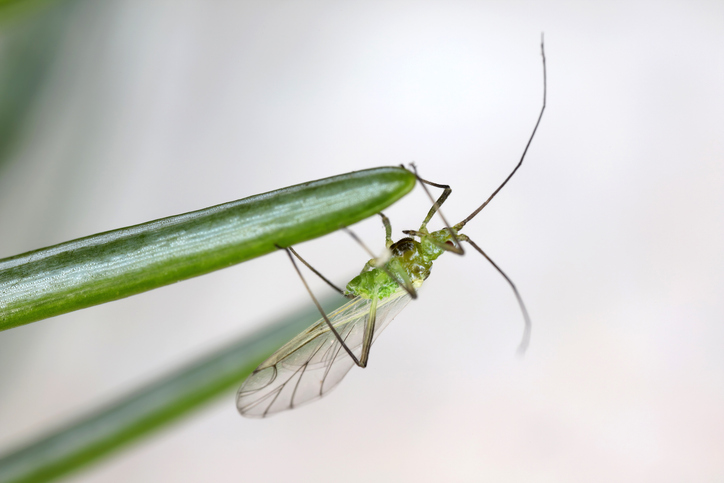
Principle species colonised.
Green spruce aphids are mostly exclusively of spruce trees
Identification.
Adult green spruce aphids are small, pale to dark green, and range in length from 1 to 2 mm (see above and top picture). Because of this, it is unlikely that they will be visible unless the tree is examined closely at the right time of year. Adults in the UK are nearly invariably apterae, or wingless.
The threat to host.
Even while defoliation caused by green spruce aphids causes comparatively few tree fatalities, the loss of needles has an impact on the growth of trees by decreasing leader extension and timber volume increase. This may cause the trees to take longer to reach economic maturity, which could have an impact on Sitka spruce-dependent businesses and jobs.
Green spruce aphid infestation also increases a tree’s vulnerability to other death-causing factors like dehydration and bacterial and fungal infections. Therefore, there is a chance that the combined consequences of these concerns could discourage timber growers from cultivating Sitka spruce, which is otherwise well suited to British growing conditions and market needs, if the aphid cannot be managed economically.
Impact / Effect / Significance
In order to establish new buds, green spruce aphids consume the needles and draw nutrients from the sap that has been stored there throughout the winter. The amount of nutrients extracted from each individual tree is quite small and does not negatively impact the tree’s health on its own. The toxins that green spruce aphids emit while they eat are what cause the damage caused by an infestation. The needles develop chlorotic bands and patches as a result of these toxins. The yellowing brought on by a shortage of chlorophyll is called chlorosis.
These areas eventually come together with continuous feeding, causing the needle to become brown, die, and fall off the stalk. This can result in severe defoliation when it occurs in large quantities. Defoliation limits a tree’s ability to photosynthesise as well as the amount of leaf space it has left to store nutrients for the growth of new shoots the following year. This has an impact on the tree’s growth.