Deep in the Green Labyrinth: Brazil’s Botanical Enigmas
Deep within the emerald cathedrals of the Amazon and the mist-shrouded Atlantic Forest, the line between myth and biology blurs. Here, the canopy hides secrets that defy conventional understanding—monstrosities of growth, relics of ancient civilizations, and evolutionary survivors that seem to possess a will of their own.
The Nomads and the Executioners
In the humid understory, the Walking Palm (Socratea exorrhiza) performs a slow-motion migration. Utilizing a complex system of stilt-like adventitious roots, it casts new anchors toward patches of golden sunlight while its shaded limbs wither away. It is a tree in a perpetual state of travel, literalizing the forest’s restless spirit.
Above it, a darker drama unfolds. The Strangler Fig begins as a harmless seedling in the high canopy, but its descent is lethal. It sends serpentine roots downward, slowly weaving a wooden cage around its host. Over decades, it tightens its grip, eventually standing as a hollow monument to the tree it consumed and replaced.
Relics of the Deep Past
The Brazilian earth occasionally surrenders its dead in spectacular fashion. Near Fonte Boa, a titan of the forest toppled, its massive root ball wrenching the soil upward to reveal a chilling sight: ancient ceramic urns entangled in the timber. These were the funerary vessels of a lost civilization, their occupants held in the tree’s wooden embrace for millennia—a haunting fusion of archaeology and ecology.
Anomalies of Form and Scale
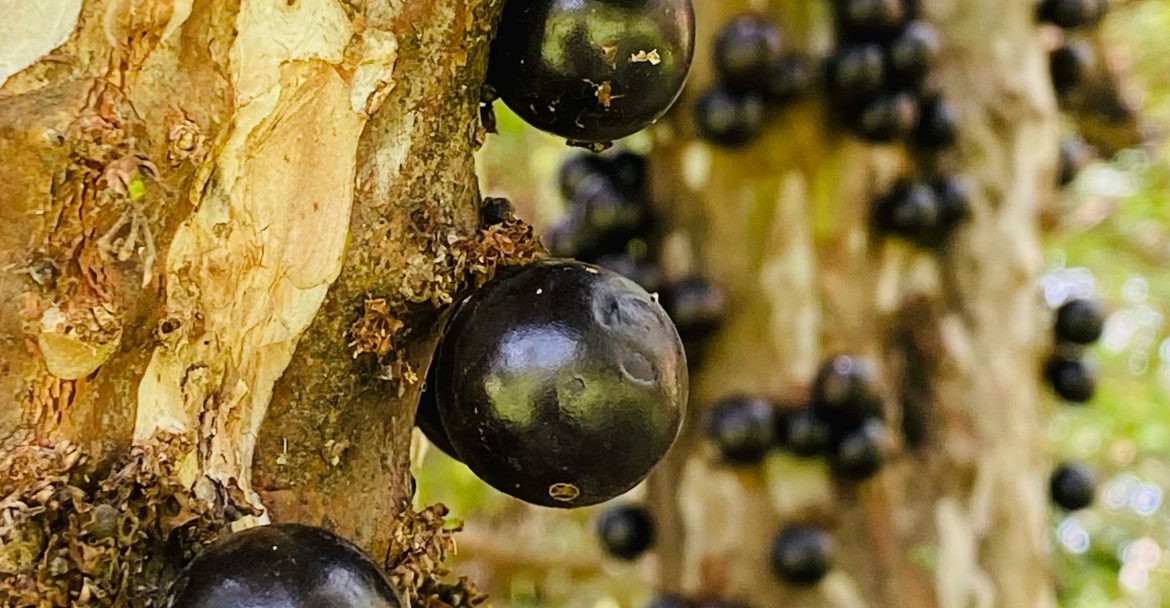
Nature takes on a surrealist quality with the Jabuticaba. Defying the standard architecture of fruit-bearing plants, its dark, orb-like berries erupt directly from the trunk and thick branches. In full bloom, the tree appears covered in a glistening, purple-black “infestation”—a biological quirk known as cauliflory that turns the forest into a gallery of the bizarre.
Even more staggering is the Great Cashew of Natal. What appears to be an entire grove is, in fact, a single organism. Driven by a genetic mutation, its branches bow to the earth and take root upon contact. This sprawling giant now blankets over 8,500 square meters, a solitary tree masquerading as a forest.
Ghost Species and Giants
The Brazilian wilds are also a realm of resurrections. In 2023, the Pernambuco Holly, a species unseen for nearly two centuries, was rediscovered in a mere fragment of forest—a reminder of the resilience of life in the face of habitat loss. Meanwhile, along the Jari River, scientists are scaling the Angelim-Vermelho, titans reaching heights of 88 meters (feet). These ancient sentinels represent the absolute limit of botanical growth, yet they remain vulnerable to the encroaching reach of man.
The Supernatural Landscape
The mystery extends to the very elements themselves. The Shanay-Timpishka, a river of boiling water fueled by deep geothermal gradients, flows through the jungle like a vein of liquid fire, lethal to any creature that slips into its current.
For the indigenous peoples of the basin, these wonders are not mere data points. They speak of “Dreaming Trees,”ancient giants that serve as conduits to the spirit realm. Here, shamans seek communion with the forest’s intellect, reinforcing a timeless truth: in the heart of Brazil, the trees are not just the scenery—they are the story.