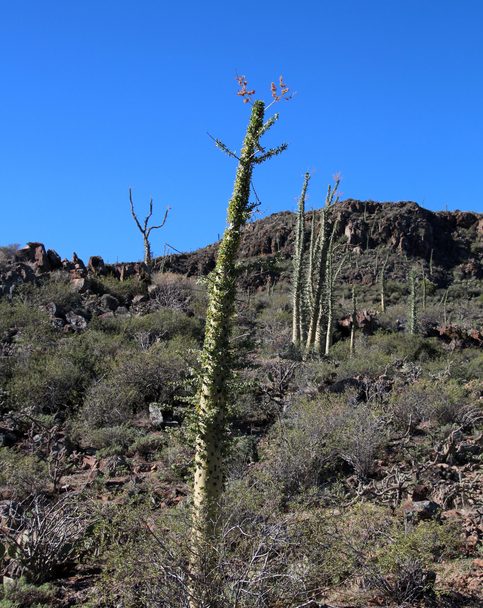
The Seussian Sentinel: Surviving the Stark Beauty of the Baja
In the sun-bleached expanse of Mexico’s Baja California Peninsula, the horizon is interrupted by a silhouette that defies botanical logic. Standing like a forest of giant, inverted carrots or guttering wax candles, the Boojum tree (Fouquieria columnaris) transforms the desert into a landscape plucked directly from the mind of Lewis Carroll.
A Masterpiece of Arid Adaptation
To survive in a realm that receives fewer than five inches of rain a year, the Boojum—known locally as the cirio—has evolved into a living cistern. Unlike the hardwood giants of the north, this tallest member of the ocotillo family utilizes a specialized cortical water-storage network, allowing it to hoard life-giving moisture within its bizarre, tapering trunk.
In a curious reversal of the natural order, the Boojum is a creature of the cool season. While other flora might bask in the summer sun, the Boojum retreats into a defensive dormancy during the blistering heat. It awakens only when the winter winds arrive, sprouting small, succulent leaves between October and April to take advantage of the fleeting desert moisture.
The Architecture of Time
Growth for the Boojum is not measured in seasons, but in lifetimes. It is one of the slowest-growing organisms on the planet—a testament to the grueling reality of desert life.
-
The Long Game: A Boojum that stands just five feet tall may have been rooted in the soil for half a century.
-
The Skyward Reach: Though growth is glacial, patience pays off. Mature specimens typically reach 25 to 70 feet, with one record-breaking giant soaring to a dizzying 86.5 feet.
The name “Boojum” itself reflects this inherent strangeness. In 1922, explorer Godfrey Sykes, struck by the tree’s alien appearance, named it after the elusive, mythical creature in Lewis Carroll’s The Hunting of the Snark. To the Spanish-speaking world, it is the cirio, an “altar candle” illuminating the desert’s vast, open-air cathedral.
“It is a botanical ghost, a tapering spire of wood and water that stands as a silent witness to the passage of centuries.”
A Protected Heritage
The Boojum’s range is a narrow, fragile corridor, found almost exclusively in the central Baja Peninsula with a small, isolated outpost in Sonora. Because of its limited habitat and the decades required to reach maturity, the tree is a protected species under Mexican law and international CITES agreements.
This scarcity has birthed a specialized market. For the rare nursery-grown specimen—the only legal way to own one—collectors may pay a king’s ransom, with prices reaching up to $1,000 per foot. Yet, even in cultivation, the Boojum remains a stubborn resident of the wild; it demands the harshest, most well-draining sandy soils and a relentless sun to truly thrive.