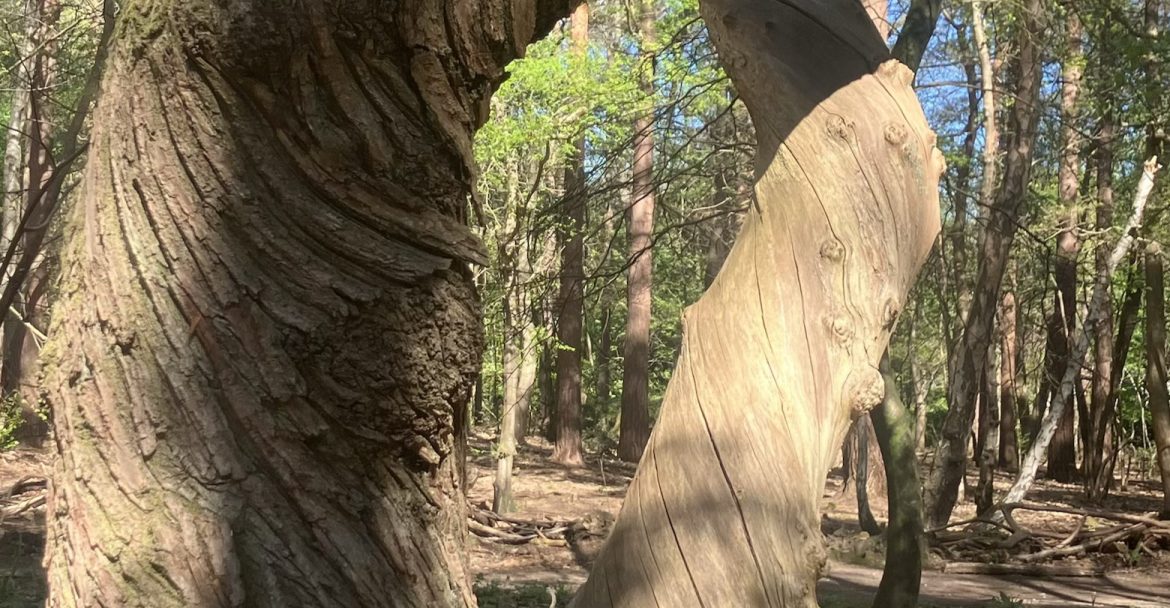
The Science of Spiral Grain: Why Trees Twist
Trees often develop twisted stems, a phenomenon known as spiral grain. This growth pattern is primarily an evolutionary adaptation designed to enhance structural integrity and optimize resource management under environmental stress.
Core Mechanisms of Spiral Growth
The transition from straight to spiral growth serves several critical biological and mechanical functions:
-
Structural Stability & Wind Resilience In high-exposure environments, such as mountain ridges, constant wind pressure forces woody fibers to develop in a spiral. This configuration increases the trunk’s flexibility, allowing it to dissipate kinetic energy by bending rather than snapping.
-
Optimal Resource Distribution (Lateral Translocation) While straight-grained trees typically transport water to branches directly above the root source, spiral grain enables lateral translocation. This allows a single root to distribute nutrients to branches around the entire circumference of the tree—a vital survival trait in rocky or nutrient-poor soils.
-
Phototropism & Heliotropism Twisting can be a response to light availability, allowing the tree to optimize foliage density and track the sun’s path more effectively throughout the day.
Primary Drivers of Spiral Development
The development of a spiral grain is rarely the result of a single factor, but rather a combination of genetic and environmental influences:
Visibility and Identification
In many species, spiral growth is an internal structural feature that remains hidden during the tree’s lifespan. The pattern often only becomes visible under specific conditions:
-
Bark Shedding: As certain trees age, the external bark may fall away to reveal the twisted wood beneath.
-
Spiral Snags: After a tree dies and the bark decays, the skeletal remains—known as “spiral snags”—clearly display the dramatic winding pattern of the internal fibers.
Note: Spiral grain is a sophisticated “engineering” solution that balances the rigid requirements of height with the fluid requirements of environmental endurance.