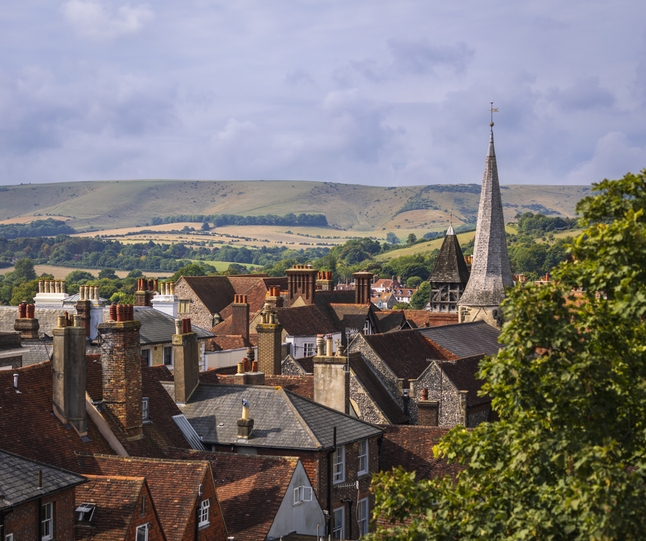
In the rolling chalkhills of East Sussex, where ancient roots run deep beneath the historic market town of Lewes, a quiet environmental watershed has quietly taken shape.
In a groundbreaking move for the United Kingdom, Lewes Town Council has formally recognized that its vibrant living canopy—from sprawling ancient woodlands and dense countryside hedgerows to individual standouts like the centuries-old mulberry tree in Grange Gardens—possesses an inherent “right to flourish.”
The declaration asserts a fundamental principle: trees have a right to maintain their natural life cycles, ecological functions, and evolutionary processes. While previous conservation milestones in the UK have granted similar rights to specific rivers or isolated landmarks—such as a single yew tree in neighboring Rother—Lewes becomes the nation’s first town to extend these rights to its entire arboreal population.
For local conservationists and residents, the move reflects a profound shift in how humans view the natural world. Amid worsening summer heatwaves and increasingly erratic weather patterns, trees are no longer viewed merely as scenic backdrops or urban obstacles, but as vital living infrastructure.
“What we need is anything that will help cool our houses, cool the rivers, cool the land, cool our own gardens so they don’t all just shrivel up,” notes Green Party Councillor Dinah Morgan, emphasizing the urgent need to view trees as ecological partners rather than commodities.
A Cultural and Legal Catalyst
While the motion does not grant binding legal powers or override national planning laws, its true power lies in its potential to reshape public consciousness and influence policy.
As one of only two designated “arboretum towns” in Britain—alongside Sidmouth in Devon—Lewes is attempting to bridge the gap between human development and ecological survival. Legal experts suggest the motion could provide crucial leverage for residents and local authorities seeking to defend urban canopies against property developers and insurance claims.
“It’s basically a stronger means of not only legal protection, but changing society and remembering we are part of nature and not above it,” explains Dr. Joanna Smallwood, an associate professor of law at the University of Sussex who assisted in drafting the campaign.
As neighboring communities along the River Ouse catchment watch closely, Lewes’s bold charter may mark the beginning of a broader movement across the British Isles—one that recalibrates our relationship with the ancient, leafy giants that make life on Earth possible.